
If your child is in seventh or eighth grade, you have probably heard other parents talking about high school. Which schools. Which programs. When applications open.
Those decisions can wait a few months. Preparing for high school can’t, because the skills that make ninth grade go well take time to build. Ninth graders who settle in fast can manage a long assignment, work without someone checking each step, and speak up in a room full of people. Your child builds those skills in grades 6 to 8, and they carry into any high school.
Here are five things you can check at home this year.
Is my child ready for high school? A quick check
- Has your child finished a project that took several weeks? High school brings research papers, lab reports, and presentations that stretch over a month. A student who has only done work due tomorrow hasn’t practiced breaking a big task into pieces.
- What does your child do when stuck? Watch the next time homework gets hard. Do they try another way, look something up, ask a specific question, or wait for you?
- Can your child explain their thinking out loud? Ask them to walk you through how they solved a problem. High school teachers grade discussions and presentations, and that skill counts in every class.
- Does your child plan their own week? Let them map out their assignments before you do. High school teachers check in less often than middle school teachers.
- What does your child want to get better at? Interests that show up in middle school often point toward the right high school program.
If you answered “not yet” to a few, you have time. Two school years is long enough to build these habits if your child practices them every week.
Middle school skills that matter most for high school
In our view, three skills matter more than any single subject: managing long projects, working independently, and speaking up in a group. Underneath all three sits a fourth, being willing to stay with a problem before you know the answer. We have written more about that in our post on critical thinking.
A child can’t learn these from a worksheet. They learn them by doing real work, getting stuck, and finding a way through, with a teacher close enough to step in at the right moment.
How our middle school builds them
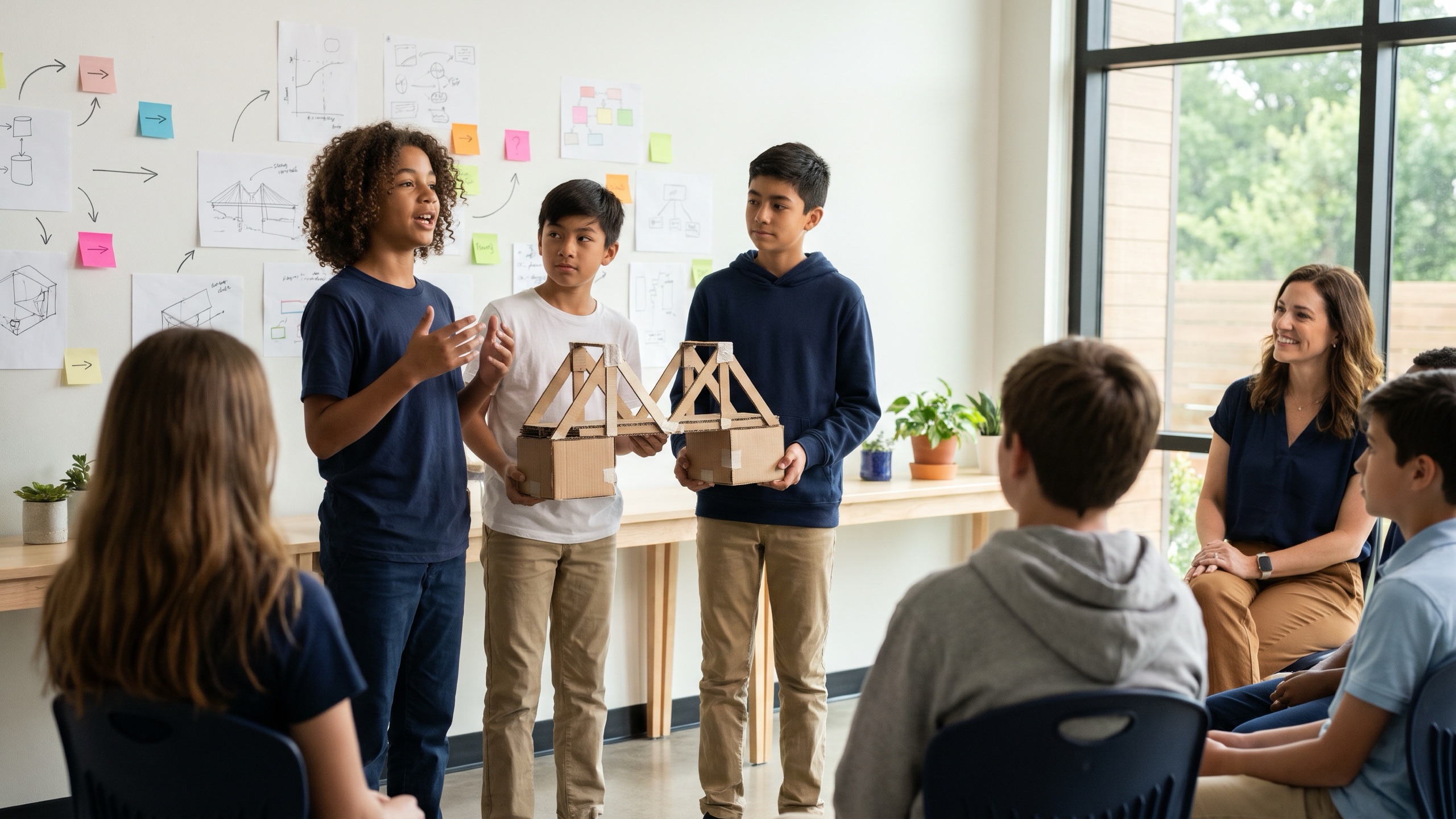
Our students practice these skills each week because inquiry and projects drive the whole middle school program.
- Students plan, research, build, test, revise, and present long projects, so they learn to manage time because the work demands it.
- In science, they design investigations, collect data, and argue from evidence.
- Design thinking challenges give them open-ended problems with more than one good answer, where the first idea rarely works.
- Teachers let students stay with a hard problem instead of handing over the answer. Students learn independence there.
- Community trips tied to each unit take learning out into The Woodlands area. Read more in our post on middle school field trips.
Our low student-to-teacher ratio helps. Teachers know each student well enough to see who needs more structure on a long project and who is ready for more responsibility.
Parents see the change in speaking up most of all. In our parent video, one parent described kids “starting the year very nervous to do any presentations or talk in front of people.” Students here present so often, the parent said, that “by the time they get halfway through the year, they’re so much more confident.”
Our STEAM high school opens in August 2028
Today’s seventh graders will start high school in fall 2028. That is the same month Discovery School of Innovation opens its high school.
The high school will offer a STEAM-based program (science, technology, engineering, art, and math) with advanced academic options and leadership training. STEAM combines technical and analytical subjects with creative expression, design, and human-centered thinking. Students will take on open-ended challenges modeled on real-life problems, using trial and error, inquiry, and collaboration. Along with academics, the program builds communication, empathy, adaptability, and imaginative design.
The skills on the checklist above are the same ones the high school will ask students to use from the first week. We built the middle school and high school to connect.
For more on keeping kids this age engaged, see our post on middle school engagement.
Have a sixth, seventh, or eighth grader? Come see how our middle school works and ask about the high school while you are here. Schedule a tour of Discovery School of Innovation in The Woodlands area, or call (281) 939-8139.