Why Middle School Field Trips Experiential Learning Works at This Age
Ask a middle schooler what they remember from sixth grade. They probably won’t describe a worksheet. They’ll tell you about the time they stood inside a working water treatment facility and realized, in a way no diagram could convey, where the water in their kitchen actually comes from.
That gap — between information on a page and understanding that sticks — is exactly what experiential learning is designed to close.
This isn’t a philosophy piece. It’s a practical look at what happens to middle schoolers’ learning when the world becomes the classroom — and why that matters at this specific stage of development.
Why Middle School Is the Right Time for Experiential Learning and Field Trips
Middle school is a distinct cognitive moment. Students between ages 10 and 14 are moving from concrete thinking toward abstract reasoning — but they aren’t fully there yet. They learn best when abstract concepts are anchored to something real they can touch, observe, or interact with.
Psychologist Jean Piaget described this as the transition to formal operational thinking. Educator and philosopher John Dewey spent decades arguing that this transition happens faster — and deeper — through experience than through passive instruction.
The research broadly supports both of them. A 2014 study in the journal Theory & Research in Social Education found that students who participated in structured field experiences demonstrated stronger recall, more nuanced analysis, and greater motivation to pursue related topics independently — compared to students who received traditional classroom instruction on the same content.
What ‘Replacing a Worksheet’ Actually Looks Like
A worksheet can test whether a student read something. A field experience tests whether they understood it — and makes it far more likely that they will.
Here’s a concrete comparison. A unit on ecosystems could unfold two ways:
Traditional approach
Students read a chapter on food webs, label a diagram, answer comprehension questions, take a quiz. Some will retain the vocabulary. Fewer will understand the relationships. Almost none will be curious enough to look further.
Experiential approach
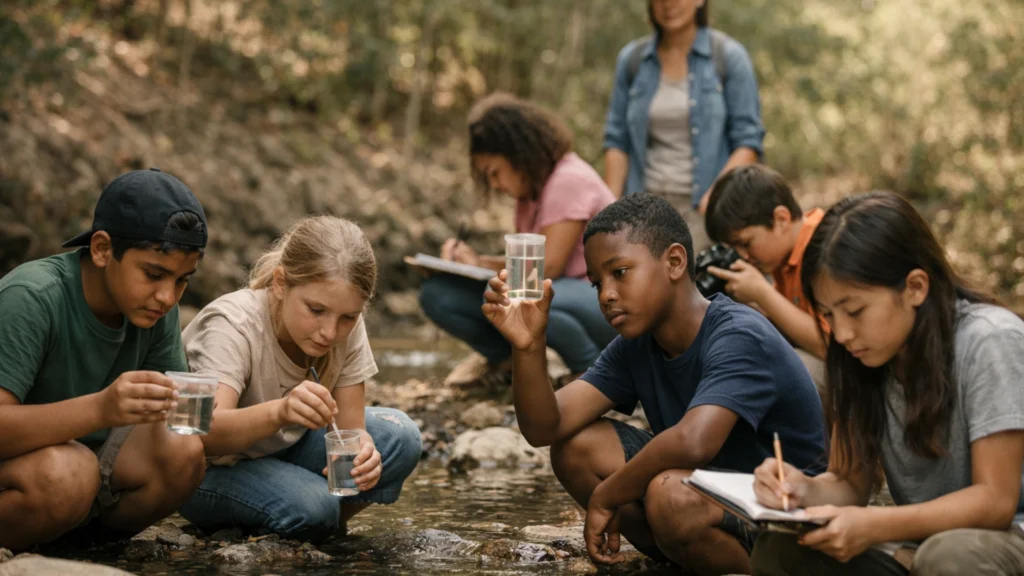
Students visit a local nature preserve. Before they go, they form a research question as a group. On site, they collect water samples, observe insect populations, document plant species, and photograph evidence of animal activity. Back in the classroom, they analyze their findings, build a food web from what they actually observed, and present their conclusions.
The content is identical. The depth of understanding — and the likelihood of remembering it a year later — is not.
The Skills That Develop in the Field (Not the Classroom)
Real-world learning builds a different set of competencies than seat work — ones that are harder to teach but more durable in practice.
Observation over assumption
In an unfamiliar environment, students have to slow down and actually look. They notice details, ask questions about what they’re seeing, and learn to suspend judgment until they have more information. That habit of observation carries directly into science, writing, and critical thinking.
Collaboration under real conditions
Field trips require students to coordinate, share equipment, divide tasks, and reconcile different interpretations of the same data. These aren’t hypothetical group dynamics — they’re live, with real stakes. Middle schoolers in particular develop social-emotional skills faster when collaboration has a genuine purpose.
Tolerance for ambiguity
Worksheets have answer keys. The real world doesn’t. When students encounter something that doesn’t fit their expectations — a plant species that shouldn’t be there, a neighborhood that contradicts a historical account they read — they have to sit with uncertainty and figure out what to do with it. That’s a skill that no fill-in-the-blank exercise can develop.
Questions that come from curiosity, not compliance
Something happens when a student sees something unexpected in the world. They ask questions that aren’t on any lesson plan — and those are often the most generative questions a teacher encounters. Experiential learning creates space for that kind of intellectual surprise.
What Makes a Field Trip Educational — Not Just a Day Out
Not all field trips work equally well. A trip to a museum with no preparation, no student inquiry, and no follow-through is closer to a reward day than a learning experience.
The research on what makes field experiences effective is fairly consistent. Three elements matter most:
- Pre-trip framing: Students need a real question to investigate, not just background information. The question should come partly from them.
- Active engagement on site: Students should be doing something — collecting, interviewing, documenting, building — not just listening to a guide.
- Post-trip synthesis: The most important learning often happens afterward, when students connect what they observed to what they already knew and identify what changed.
Without all three, a trip is an outing. With them, it’s a unit of study that happens to take place somewhere meaningful.
What Parents Often Notice First
Parents whose children learn this way often describe the same shift: their kid comes home and keeps talking. Not about the trip itself, but about the subject the trip opened up.
A student who visited a local architecture firm during a unit on urban planning starts noticing building designs on the drive home. A student who spent a morning interviewing elderly community members for an oral history project starts asking their grandparents questions at dinner.
That continuation — learning that doesn’t stop when the school day ends — is one of the clearest signals that something real happened.
A Different Kind of Accountability
Worksheets are easy to measure. Completed or not. Correct or not. They produce data that’s simple to report.
Experiential learning produces something harder to quantify and harder to forget: a student who understands why something matters, not just what it is.
Middle school is when many students either catch fire or check out. The conditions that tip that balance are rarely found in a packet of review questions.
They’re found in places where learning requires something of the student — attention, curiosity, and engagement with something real.
Schedule a tour to learn more about Discovery School of Innovation.
SEO METADATA
Focus Keyword:
SEO Title (≤60 chars): How Field Trips Replace Worksheets in Middle School
Meta Description (≤155 chars): Middle schoolers learn more when the world is their classroom. Here’s how real-world field trips build deeper understanding than any worksheet can.
Slug: /middle-school-field-trips-real-world-learning
Secondary Keywords: experiential learning middle school, project-based learning The Woodlands, Reggio middle school
Internal Links: Curriculum philosophy page, Admissions, Schedule a tour CTA