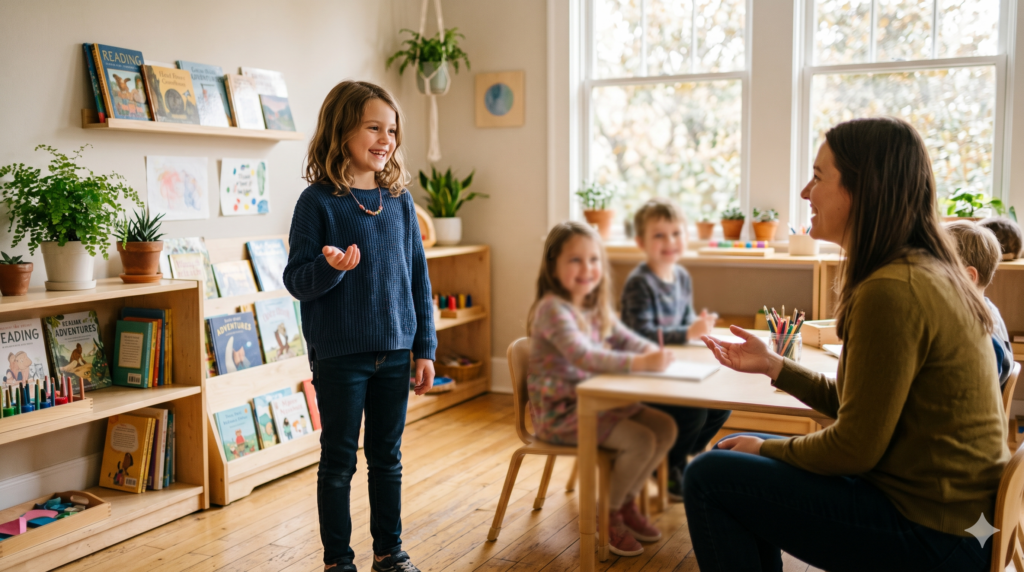
If mornings at your house mean a battle to get out the door, you already know what school anxiety looks like up close. The stomachaches. The foot-dragging. The quiet kid who used to be curious and now just wants to stay home. For a lot of families in The Woodlands, Spring, and Conroe, that daily struggle becomes the new normal, and it’s exhausting for everyone.
It doesn’t have to stay that way. Sometimes the issue isn’t your child. It’s the fit between your child and their school.
[VIDEO]
(https://youtu.be/8YtR03xl56Y)
What Parents Actually Notice When School Anxiety Eases
Before we go further, hear directly from a Discovery School parent whose children went from resisting school to genuinely enjoying it.
One mom told us her kids came from another private school she thought was good, until she saw something different was possible. Now, in her words, it’s the first time she hasn’t had to fight them in the morning to go to school, and when she picks them up, they’re a little sad to leave.
That’s the shift parents describe most often. Not a test score. A child who wants to be there.
Another family watched their severely dyslexic daughter struggle at a previous school where, they later realized, real gaps were going unaddressed. Here, those gaps got attention, and you’d be hard-pressed to tell she’s dyslexic now. Her parents say she’s matured, come out of her shell, and made progress they’re genuinely proud of.
These aren’t guarantees, and we’d never pretend every child’s path looks the same. But the pattern is real, and it usually starts with anxiety going down before anything else goes up.
Why the Right Setting Calms School Anxiety
School anxiety rarely comes from one big thing. It builds from small, daily pressures: a classroom too crowded to ask for help, a pace that leaves your child behind, the dread of being called on when you’re already lost.
Many parents are surprised to learn that school anxiety often looks like stomachaches, exhaustion, irritability, or a sudden dislike of school.
In a large class, those pressures stack up with nowhere to release. A child who’s struggling learns to keep quiet and hope they’re not noticed. That’s survival, not learning.
Smaller settings change that equation. When a teacher truly knows your child, they catch the worry early, before it hardens into a daily fear of school. Our small class sizes are built for exactly this kind of attention. Learn more about our small class sizes.
Confidence Is Something Kids Practice, Not Just Feel
One detail from our parents stuck with us. Their kids were nervous to present or speak in front of people, but because they do it so often here, by midway through the year that anxiety had faded and confidence had taken its place.
That’s the part people miss about confidence. It isn’t a personality trait some kids are born with. It’s a muscle, and it grows with reps in a setting that feels safe enough to try.
When a child isn’t bracing against anxiety all day, they have room to raise a hand, take a risk, and discover they’re more capable than they thought. That’s what personalized learning and student engagement is really for, meeting each child where they are so they can stretch from there.
A Note for Parents Still Deciding
If your gut has been telling you something isn’t working, that instinct is worth trusting. You know your child better than any school does.
We won’t promise to fix everything, and we’d be skeptical of any school that did. What we can say is that many families come to us after another school, sometimes a good one on paper, and tell us the change in their child surprised even them.
According to the American Academy of Pediatrics, ongoing school refusal and anxiety are worth taking seriously rather than waiting out. The right environment is a big part of the answer for a lot of kids.
American Academy of Pediatrics
School Anxiety in The Woodlands: When a Different Approach Helps
Discovery School of Innovation serves families across The Woodlands, Spring, and Conroe. We’re a private school for Pre-K4 through Grade 8, with high school on the way. We’re glad to walk you through our tuition and what it includes.
The best way to know if a school can ease your child’s school anxiety is to stand in it. Watch a real class. Ask hard questions. See how the kids actually act.
CTA: Schedule a tour or reach out to learn more. Come see a normal school day for yourself, and decide whether it feels like the right fit for your family.