
Winter break is a few weeks away. Somewhere around day three, your child will ask for the tablet, and you will be tired enough to say yes.
Before that day comes, you should know about a study published this fall. Researchers combined 23 earlier analyses covering 2,817,252 children in 64 countries. On average, kids who spent more time on screens had lower overall grades and weaker language skills. The good news is in the details, and the details tell you what to do.
What the screen time study found
A team led by researchers at the University of Calgary published the review in JAMA Pediatrics on September 28, 2026. They studied children and teens 18 and under. More screen time went along with:
- lower overall school achievement
- weaker language skills
- more behavior problems, and more trouble with emotions and friendships
- more anxiety and low mood, including in kids who use social media
Reading, math, and science scores on their own showed no clear link. Neither did executive function, the skills a child uses to plan and stay on task.
Does screen time cause lower grades?
The study can’t answer that, and you should read it with three limits in mind.
First, the links are modest. Lots of kids use screens and do well in school.
Second, the researchers observed families as they live. A child who already finds school hard may drift toward a device, and a busy household may hand one over more often. Screen time and lower grades show up together, but the study can’t tell you which one drives the other.
Third, “screen time” lumps together a video call with Grandma, a coding project, and two hours of autoplay. The authors found the results changed with the type of screen and the child’s age. They also called screen use a factor families can change. That is the part you can act on.
How we use technology at Discovery School of Innovation
Our students code, build robots, research, and learn how AI works and where it gets things wrong. You can read how we think about it in our post on balancing AI for kids.
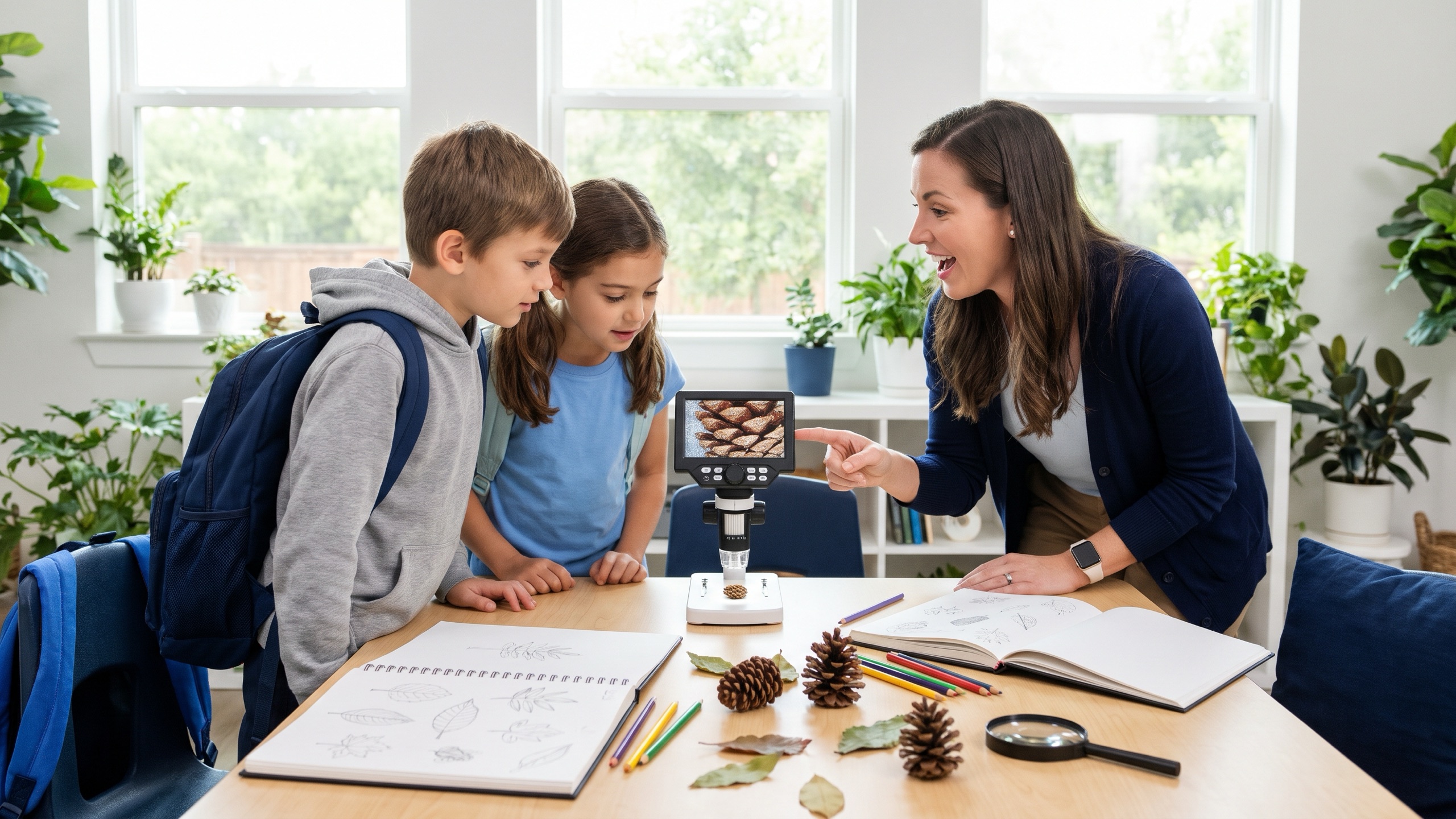
We believe a screen should serve something a child is making or investigating. So most of the day here is hands-on. Students learn math with materials they can move and draw. They run their own science investigations. Projects start from their questions and end with them explaining their work to an audience.
That last habit matters for the language finding. Kids build language by talking: explaining an idea, defending it, and answering a follow-up question from someone who wants to know more. Our classrooms run on discussion and group work for that reason. In addition to 50 minutes of recess each day, students get 15 minutes of Quiet Time to rest, read, or work on something on their own, with no device.
Families notice it at home. In a short video about why parents choose Discovery, one parent said: “My kids love this school. It’s the first time that I’ve not had to fight them in the morning to go to school.”
See how learning looks at each grade on our Academics page.
Screen time rules for winter break
The American Academy of Pediatrics no longer gives school-age kids one daily number. Its family media plan guidance asks families to set rules together and revisit them over holiday breaks. Screenshot this list and try it before break starts.
- Write the plan with your kids. The AAP’s free Family Media Plan tool takes a few minutes. Kids keep rules they helped write.
- Choose two or three screen-free times. The AAP suggests dinner, homework time, and the hour before bed.
- Turn off autoplay and notifications. App makers design both to keep kids watching longer.
- Ask what the screen is for. A stop-motion movie or a call with a cousin leads somewhere. Scrolling rarely does.
- Get your child to explain what they watched. Then ask a real follow-up question. You just turned a show into language practice.
- Put your own phone away at dinner. Your kids are watching you too.
Fill the space you free up with cooking, building, card games, and time outside.
Choosing a school for next fall? Come see a classroom where technology serves the learning. Schedule a tour of Discovery School of Innovation in The Woodlands area, or call (281) 939-8139 and ask how a project unfolds over a few weeks in your child’s grade.