You pick your child up from school and ask how the day went. You get a shrug. Maybe a “fine.” Then you watch them melt down over a worksheet at the kitchen table an hour later, and you wonder if they’re actually learning anything at all.
If that sounds familiar, you’re not imagining it. A lot of parents tell us the same thing: their kids seem checked out. And often, the missing piece behind low student engagement isn’t motivation or ability. It’s that children are being asked to sit still and absorb information for far longer than their brains are built to handle.
There’s a simple, research-backed idea changing that, and it’s probably not what you’d expect.
What a Brain Break Actually Is
A brain break is a short, intentional pause, usually three to five minutes, where kids step away from the academic task in front of them. It might be movement, a quick game, a breathing exercise, or a moment to connect with a classmate.
It sounds almost too simple. But the research is clear. Short movement breaks help students refocus and improve how well they hold onto what they’re learning. Kids, like adults, naturally cycle through periods of attention and inattention. By middle school, focused study of around 20 to 30 minutes calls for a brief reset.
In other words, the kid staring out the window after 25 minutes isn’t being difficult. Their brain is doing exactly what brains do.
The problem is that in a classroom of 28 students, a teacher rarely has room to notice that moment, let alone respond to it. The lesson keeps moving. The disengaged child gets further behind, feels it, and starts to dread school.
Why Student Engagement Falls Apart in Crowded Classrooms
Here’s the honest version most brochures won’t give you.
When a class is large, the day runs on a single pace. There’s one speed, one transition schedule, one moment to move on whether your child is ready or not. A teacher managing that many kids can’t pause to let a restless eight-year-old reset without losing the whole room.
So the breaks don’t happen. The afternoon slump sets in. And by the time your child gets home, they’ve spent hours pushing against their own attention span. That’s where the homework battles, the anxiety, and the “I hate school” comments often come from. It’s not always the content. It’s the relentless pace with no room to breathe.
Smaller settings change the math. When a teacher has a handful of students instead of a crowd, they can actually read the room, notice when energy drops, and build in those resets before frustration takes over.
How We Use Brain Breaks to Support Student Engagement
At Discovery School of Innovation, brain breaks aren’t a reward or a time-filler. They’re part of how we structure the day.
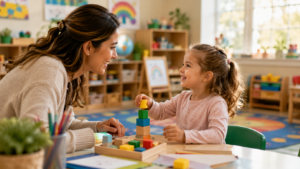
Our teachers work with small groups, which means they can see when a child needs to move, reset, or reconnect before pushing into the next concept. A creative pause with building blocks. A minute of mindful breathing before a tricky lesson. A quick partner activity that gets kids out of their seats. These small resets help children come back ready instead of fried.
This connects to something we care about deeply: personalized learning. A brain break for a wiggly Pre-K4 student looks nothing like one for a Grade 7 student wrestling with a dense reading. When you know each child, you can match the reset to the kid. That’s hard to do in a packed room and natural in a small one.
The goal isn’t to make school easier. It’s to remove the unnecessary friction so the actual learning can land.
Brain Breaks vs. Screen Time: They’re Not the Same
A quick clarification, because parents ask about this a lot.
When some schools say they give kids “a break,” they mean a tablet or a video. That’s not a brain break. Passive screen time doesn’t reset attention the way movement, creativity, and human connection do. If anything, it often leaves kids more scattered.
Real brain breaks are active and low-tech on purpose. Stretching, moving to a new part of the room, a short game, a moment of quiet. Many parents who come to us are specifically frustrated with how much of their child’s school day happens behind a screen. This is one of the practical ways we keep learning human and hands-on.
What This Looks Like for Your Child
Picture a normal Tuesday. Your child works on a math concept, hits the wall around the 25-minute mark, and instead of being told to push through, gets a two-minute movement reset. They come back, finish strong, and head home with less in the tank to burn off at dinner.
Over a week, that’s a child who associates school with feeling capable instead of overwhelmed. We won’t promise that fixes everything, no honest school can. But it’s a meaningful, daily difference, and it adds up.
Children who feel regulated and seen tend to participate more. They take more risks. They build the kind of quiet confidence that’s hard to teach directly but easy to notice when it shows up.
Choosing a School Where Your Child Stays Engaged
If your child has been coming home checked out, it’s worth asking any school you tour a direct question: how do you handle a kid who’s losing focus? The answer tells you a lot.
Discovery School of Innovation serves families across The Woodlands, Spring, Conroe, and Magnolia, with a new campus opening in the Woodlands in August 2026. We’re a private school serving Pre-K4 through Grade 8, with high school on the way. Tuition is $18,500 per year, and we’re happy to walk you through exactly what that includes.
You know your child better than anyone. If your gut is telling you they need a setting that works with how they actually learn, not against it, we’d love to show you what that looks like in person.
CTA: Schedule a tour or reach out to learn more. Come see a real school day, ask your hardest questions, and decide for yourself whether it’s the right fit for your family.