Somewhere between the third birthday and the fourth, the question sneaks up on you: is my child ready for Pre-K?
Maybe a friend mentioned her daughter already knows all her letters. Maybe your son still cries at drop-off with Grandma. Maybe you’ve started googling checklists at 10 p.m. and closing the laptop more anxious than when you opened it.
Before you take one more quiz, we want to offer you a different way to think about the whole question — one that comes from a small city in northern Italy, and one that might take a weight off your shoulders.
Your child was born ready
After World War II, in the town of Reggio Emilia, Italy, an educator named Loris Malaguzzi helped parents build a new kind of school around a radical idea: children aren’t empty containers waiting to be filled. They arrive curious, capable, and full of ideas — speaking what Malaguzzi called “a hundred languages”: drawing, building, dancing, pretending, questioning, a hundred ways of making sense of the world.
That philosophy — the Reggio Emilia approach — now shapes schools in more than 145 countries, and it’s the foundation of our Pre-K4 classroom here in The Woodlands. You can read about its origins at Reggio Children, the organization that carries Malaguzzi’s work forward today.
Here’s why that history matters to your 10 p.m. googling: in this view of childhood, your four-year-old is already ready to learn. He’s been doing it ferociously since the day he was born. The better question — the one we’d encourage you to ask on every school tour — is this:
Is the school ready for my child?
What that looks like in a real classroom
“Ready for your child” isn’t a slogan. It shows up in concrete, visible ways — and once you know what to look for, you can spot it (or its absence) in the first ten minutes of a visit.
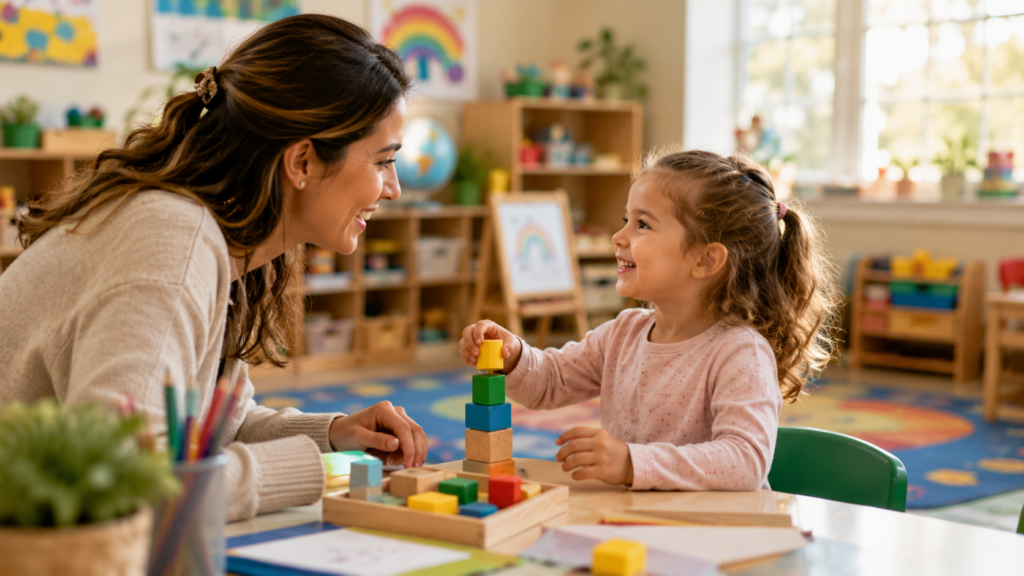
The curriculum follows the children. In a Reggio-inspired classroom, teachers don’t march through a fixed script in September regardless of who’s in the room. They watch what captures the children’s curiosity — the roly-polies by the fence, the way blocks keep toppling — and build investigations from it. Educators call this an emergent curriculum. Your child calls it getting to find out.
Materials are open-ended. Look at the shelves. Are they full of single-purpose plastic toys, or of what Reggio educators call loose parts — shells, spools, fabric, stones, tubes — things a child can carry, combine, line up, take apart, and turn into anything? A cardboard tube has no instructions. That’s the point. It hands the thinking back to the child.
Messy play is welcome. Paint, clay, water, sand, shaving cream. Sensory play looks like chaos to adults, but it’s four-year-old research — infinite, open-ended, and directed by the child. A school that’s ready for your child has smocks by the sink and isn’t precious about the floor.
The room itself teaches. Reggio educators talk about the environment as another teacher. Light, natural materials, children’s work displayed at children’s height, real documentation of their projects on the walls — the space tells your child your ideas matter here before an adult says a word.
Parents are partners, not spectators. From the very beginning, Reggio schools were built with families, and family participation is still one of the approach’s core commitments. If a school treats you as a partner in your child’s learning rather than an audience for it, that’s the real thing.
A word of honesty: plenty of programs use the phrase “Reggio-inspired” while running a fairly traditional preschool underneath. The checklist above is how you tell the difference. So is a visit.
Okay — but is my kid ready for a classroom?
Fair question. Even in a school that meets children where they are, a few everyday signs make the transition smoother:
Your child can handle a goodbye (not tearlessly — just recoverably). Other adults can generally understand them when they’re hurt, hungry, or need the bathroom. Play is starting to become a team sport — inventing games with a friend, negotiating who gets to be the dragon. And “shoes by the door, then wash your hands” lands more often than not.
Notice what’s not on that list: letters, numbers, writing their name. Those are things Pre-K grows, especially when they emerge through projects a child actually cares about. In our Pre-K4 program, a child who spends a week fascinated by the class garden is doing math, science, and early literacy — she just calls it the garden.
And if your child isn’t showing every sign yet? Almost no four-year-old is. Children develop unevenly — chatty but clingy, independent but shy. In a small class where the teacher truly knows each child, those gaps close remarkably fast. That’s the quiet advantage of a school built on relationships, and it doesn’t stop after Pre-K — you can see how it carries through every grade level as children grow.
What you can do between now and the first day
No workbooks required. Read together daily. Let your child do small real things — shoes on, water bottle carried, one mess cleaned up. Say yes to mud, paint, and water more often than feels natural. Keep a basket of “junk” — corks, ribbon, boxes — and watch what it becomes. And talk about school like an adventure, because your child will borrow whatever feeling you bring to it.
You’re not preparing your child to be ready. You’re keeping alive the readiness they already have.
Come watch it in action
Reading about a hundred languages is one thing. Standing in a classroom while a four-year-old explains the city she built from loose parts is another.
We’re enrolling Pre-K4 through Grade 8 at our Woodlands campus for 2026–2027, and the best way to answer the readiness question is to visit — with your child. Review what enrollment looks like, then schedule a tour. Bring your questions. Bring your four-year-old’s questions, too. Those are the ones we’re built for.